Three Months of Art, Psychology & Learning
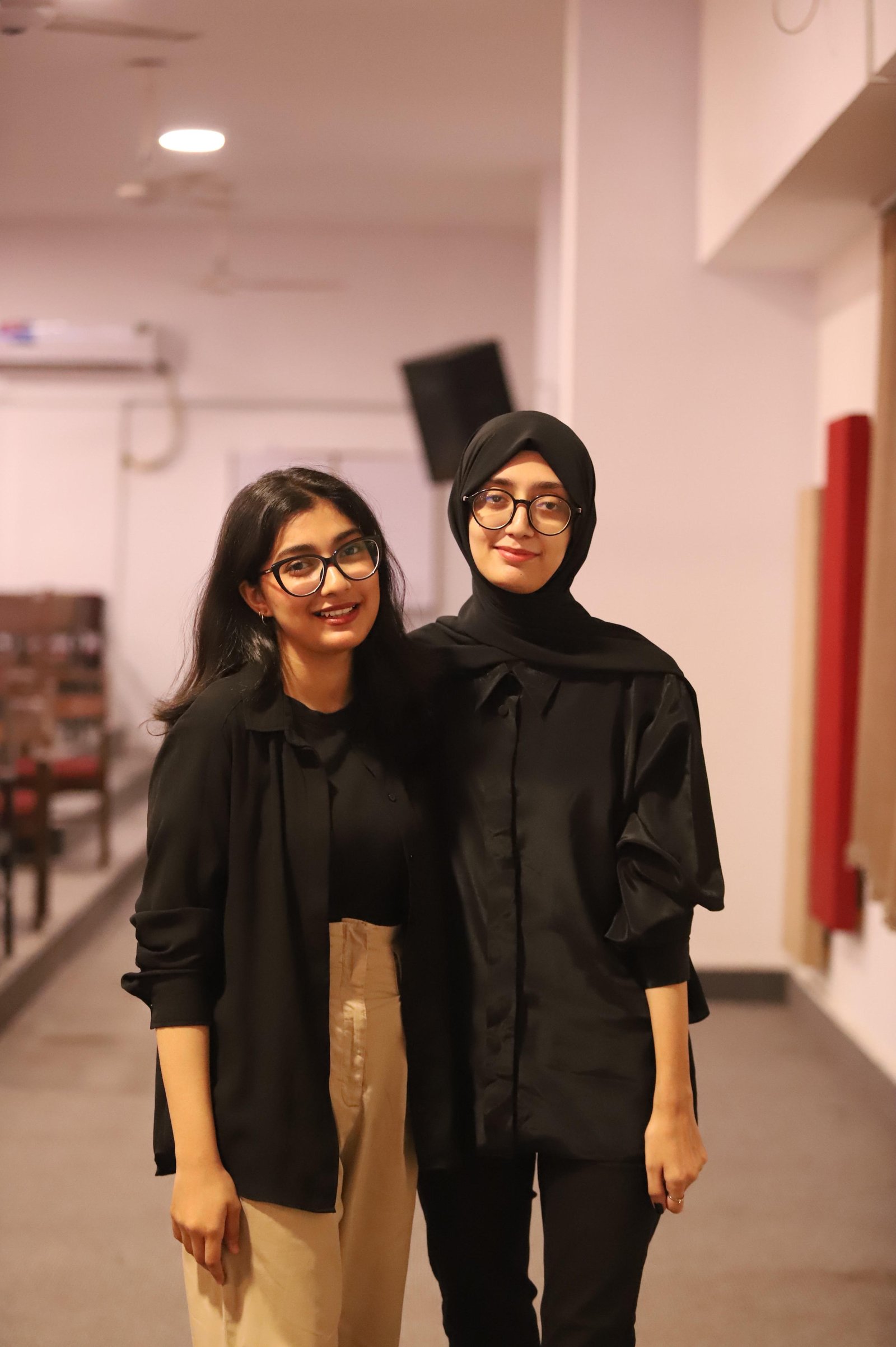
Laiba Qasim & Arwa Arif
Final Year BS Psychology · Creative Arts Facilitators, IQ Inpatient Unit
Inpatient Enrichment Volunteership · Oct 2025 – Jan 2026
Between October 2025 and January 2026, Arwa Arif and Laiba Qasim volunteered with IQ Institute’s Inpatient Enrichment Program, co-facilitating creative arts sessions for psychiatric inpatients every Saturday. Over three months, they discovered that progress is subtle, that fear gives way to curiosity, and that inpatient mental health care is not what most people think it is.
They came from different places: one drawn by the gap between theory and practice, the other by the question of whether art could help someone beyond herself. But over three months, they discovered something together.
Why They Came
For Laiba, the pull toward IQ came from a familiar tension among psychology students: the distance between classroom learning and clinical reality.
“It’s something we study a lot about — different disorders, behaviors, theories — but it still feels like there’s a gap between what you learn and what it actually looks like in real life,” she reflects. “I always wanted to explore that gap, but in a space where I could also bring in my own ideas and not just follow a fixed structure.”
After her initial interview at IQ, she felt something shift. “It felt like a place where I could think, create, and engage in my own way, which made me want to be a part of it.”
For Arwa, the motivation was different but equally clear. Art had been her comfort since childhood — a personal practice, a way of processing the world. But over time, a question began forming.
“I started feeling like… what if I could use art for something more? Like not just for myself, but to actually help someone,” she says. “That’s what brought me to IQ. I didn’t have a perfect plan in mind, I just wanted to try combining art with mental health and see if it could mean something.”
Their first days shared something in common: uncertainty.
“My first day was honestly a mix of confusion and a little bit of fear,” Laiba recalls. “It was something very new and unfamiliar, and I wasn’t sure how participants would respond to us or how we would handle the environment. Even working alongside Arwa, we both felt that uncertainty in the beginning.”
Arwa remembers the same mixture of excitement and apprehension. “I was honestly very confused and a little scared. It was my first time in an inpatient setting and before this I never really had that kind of one-on-one interaction with patients. So I was excited, but at the same time there was this fear inside me like ‘I don’t know how this is going to go.’”
But that feeling didn’t last. “Slowly, that feeling changed,” Laiba says. “Instead of being unsure, we became more curious and more open to learning. It turned into something we actually looked forward to every week. It felt like even if we weren’t doing something huge, we were still learning something meaningful every single time.”
Arwa credits the environment itself. “That feeling slowly faded because the environment there is very supportive. The psychologists and everyone around make you feel comfortable, and they give you a lot of freedom to do things in your own way. That really helped me.”
What the Sessions Actually Looked Like
The structure they developed was simple by design: arrive, greet everyone, settle into the space, then begin with something light — a short meditation, grounding exercise, or physical movement. After that, they’d move into the main activity.
“Our sessions were mostly art-based and sometimes play-based with a goal,” Arwa explains. “Nothing too complicated, just simple activities. The main thing was to let patients express themselves without any pressure.”
What they discovered quickly was that predictability had limits. “No two sessions were ever the same,” Laiba says. “Sometimes things went as planned, and sometimes they didn’t, and we had to adjust in the moment depending on how people were responding.”
Arwa noticed the same variability in engagement. “Some patients got involved quickly, some took time, and some just sat quietly.”
One session stayed with Laiba in particular. They were doing a simple activity where participants had to throw a ball into a basket. While demonstrating, she couldn’t get the ball in. But when one of the participants succeeded, they got excited and said, “We did it, even you couldn’t.”
“It was such a small moment, but the happiness and confidence in that reaction made it really memorable,” she recalls.
That moment encapsulates something both of them learned across three months: progress isn’t always visible, and sometimes the smallest responses carry the most meaning.
“One thing that really stood out to me was that progress is not always visible. Sometimes it’s very subtle. Someone just sitting in the room, observing, or responding slightly is also a form of engagement.” — Laiba Qasim
“I also realized how important patience is. You can’t rush anything in this kind of space. You have to meet people where they are and accept that everyone moves at their own pace.”
For Arwa, one of the biggest surprises was how ordinary it all felt once the initial fear subsided.
“One thing that really surprised me was how normal everything felt. It’s not scary the way people think. It’s just people who need care and understanding.” — Arwa Arif
The Hardest and Best Parts
When asked about the most difficult aspect of the work, both pointed to emotional rather than logistical challenges.
For Laiba, it was proximity. “The hardest part for me was seeing individuals, especially around my own age, struggling in ways that felt very real and personal. That’s something that doesn’t just stay in the session, it stays with you even after you leave.”
For Arwa, the difficulty was navigating unpredictability. “The hardest part for us (me and Laiba) was handling different moods and reactions. Sometimes you don’t know how they’ll respond.”
But alongside those challenges were moments that made everything worthwhile.
“The most rewarding part was the connection,” Laiba says. “When participants started recognizing us, waiting for sessions, or telling us what they wanted to do, it made everything feel worth it.”
Arwa echoes this. “The best part was when someone participated even a little.”
What Changed
Before volunteering at IQ, both carried assumptions common among students approaching inpatient mental health settings for the first time.
“I used to think people in inpatient settings might not engage much,” Laiba admits. “But I learned that they do, just in their own way and time.”
Arwa’s shift was even more fundamental: a dismantling of stigma she didn’t fully realize she carried. “One thing I wish more people understood is that inpatient mental health care is not something to judge or be scared of,” she says. “It’s just people trying to heal.”
On a personal level, the experience reshaped how both of them approach their work and their futures.
“This experience made me more patient, more observant, and more empathetic,” Laiba reflects. “It also made me realize that bookish knowledge is not enough. Real exposure gives you a completely different understanding that you can’t get otherwise.”
For Arwa, the impact was equally transformative. “This experience wasn’t just about helping others. It helped me grow a lot too.”
The volunteership also clarified something about their professional directions. Laiba, who balances psychology with graphic design work, gained insight into where her dual interests might converge.
“This journey has made one thing very clear to me; that I want to keep exploring spaces where creativity and psychology come together in a meaningful way, especially with real, human interaction,” she says.
Arwa, continuing her psychology degree with art as a constant thread, found a similar clarity. “This experience has definitely shaped how I think about my future. It made me realize I want to keep exploring this side where creativity and mental health come together.”
What They’d Tell Other Students
When asked what advice they’d give to psychology or art students considering something similar, both were direct.
“If you’re a psychology student, I’d honestly say you should try something like this at least once,” Laiba says. “Because what we study in class is one thing, but being in a space like this is completely different. It makes everything feel more real.”
She distinguishes this kind of volunteering from typical structured placements. “It’s not like a typical, structured internship where you’re just following instructions. Here, you actually get to explore your own way of engaging, your own ideas, and see what works and what doesn’t. And I think that’s the best part.”
“You don’t always feel like you’re doing something big,” she continues, “but somehow, you still end up learning a lot. Not just about mental health, but about people, and even about yourself.”
Arwa’s advice centers on moving past hesitation. “I would tell others to try it, even if they feel unsure. I was unsure too.”
And if they could go back and speak to their first-day selves — confused, uncertain, a little afraid — what would they say?
“It’s okay to feel unsure in the beginning,” Laiba reflects. “You don’t need to have everything figured out. Just showing up with openness is enough.”
Why It Mattered
Both would do it again. When asked directly, the answer from each was immediate: yes.
From their perspective, the sessions created something meaningful, even if not always visible in dramatic ways.
“From what I observed, the sessions created a small but meaningful space for engagement and expression,” Laiba says. “Even the smallest responses felt important. There were moments when participants remembered us or chose to engage, and those were the times it really felt like what we were doing mattered.”
Arwa agrees. “I do feel like our sessions made some kind of impact. Maybe not in a big visible way, but in small ways.”
For Laiba, the experience didn’t remain confined to Saturday mornings in the inpatient unit. It changed something deeper.
“For me, this experience didn’t just stay limited to learning or academics,” she reflects. “It changed how I observe, how I respond, and how I understand others. And I think that’s what made it truly meaningful.”
Arwa and Laiba are now completing their final year. Both carry the lessons from those three months — about patience, about subtle progress, about meeting people where they are — forward into whatever comes next.
And sometimes, small and meaningful is exactly enough.
Our community stories reflect the learning, compassion, collaboration and practical work that sit behind healthcare and welfare.