
From Our Community
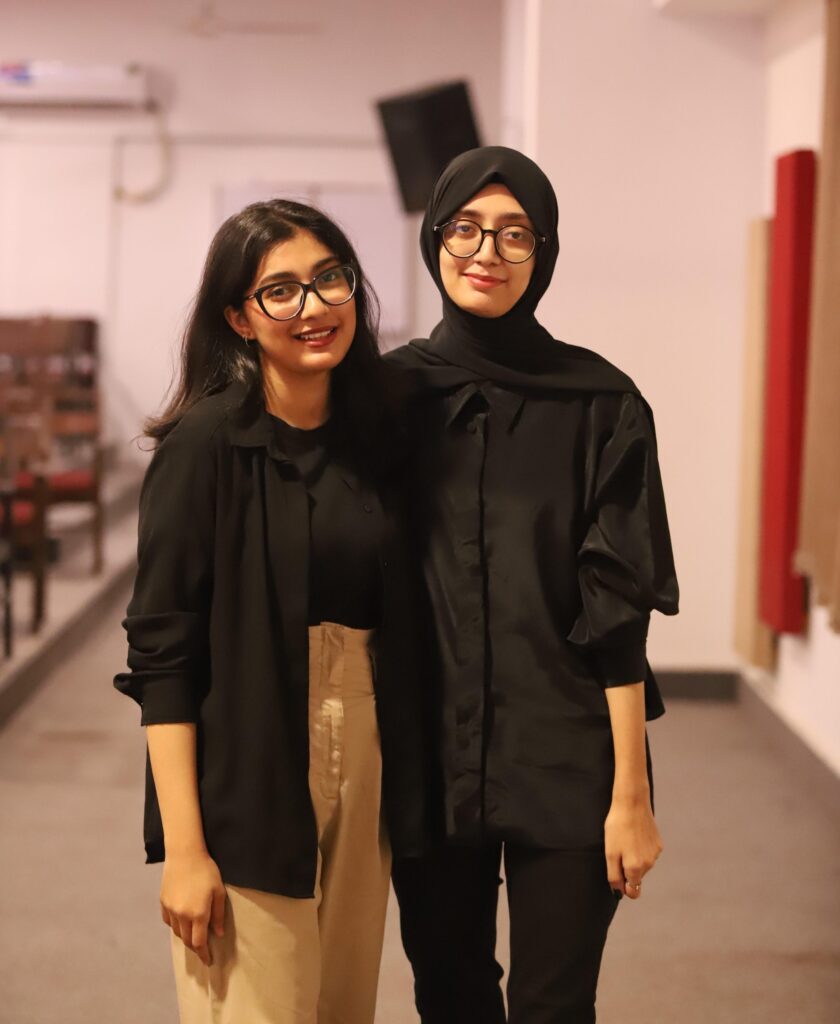
Laiba Qasim & Arwa Arif
Final Year BS Psychology · Creative Arts Facilitators, IQ Inpatient Enrichment Program
Inpatient Enrichment Volunteership · IQ Institute of Neuropsychiatry · October 2025 – January 2026
Where Are They Now
When Art Meets Psychology: Two Students, Three Months, and What They Learned in IQ’s Inpatient Unit
Between October 2025 and January 2026, Laiba Qasim and Arwa Arif volunteered with IQ Institute’s Inpatient Enrichment Program, co-facilitating creative arts sessions for psychiatric inpatients every Saturday.
They came from different places — one drawn by the gap between theory and practice, the other by the question of whether art could help someone beyond herself. Over three months, they discovered something together.
“It’s not scary the way people think. It’s just people who need care and understanding.”
Arwa Arif · Inpatient Enrichment Volunteer, 2025–2026
Why They Came
For Laiba, the pull toward IQ came from a familiar tension among psychology students: the distance between classroom learning and clinical reality. She wanted to explore that gap, but in a space where she could bring in her own ideas rather than follow a fixed structure.
“It felt like a place where I could think, create, and engage in my own way — which made me want to be a part of it.”
Laiba Qasim
For Arwa, the motivation was different but equally clear. Art had been her comfort since childhood – a personal practice, a way of processing the world. But over time, a question began forming.
“I started feeling like… what if I could use art for something more? Not just for myself, but to actually help someone. I didn’t have a perfect plan. I just wanted to try combining art with mental health and see if it could mean something.”
Arwa Arif
The First Days
Their first days shared something in common: uncertainty. Neither knew exactly how participants would respond, or how they themselves would handle the environment.
“My first day was honestly a mix of confusion and a little bit of fear. It was something very new and unfamiliar. Even working alongside Arwa, we both felt that uncertainty in the beginning.”
Laiba Qasim
But that feeling didn’t last. Slowly, uncertainty gave way to curiosity, and the sessions became something both of them looked forward to each week.
“That feeling slowly faded because the environment there is very supportive. The psychologists and everyone around make you feel comfortable, and they give you a lot of freedom to do things in your own way.”
Arwa Arif
What the Sessions Actually Looked Like
The structure they developed was simple by design: arrive, greet everyone, settle into the space, then begin with something light: a short meditation, grounding exercise, or physical movement. After that, they’d move into the main activity.
“Our sessions were mostly art-based and sometimes play-based with a goal. Nothing too complicated, just simple activities. The main thing was to let patients express themselves without any pressure.”
Arwa Arif
What they discovered quickly was that predictability had limits. No two sessions were ever the same. Sometimes things went as planned. Sometimes they didn’t, and they had to adjust in the moment.
One session stayed with Laiba in particular. During a simple ball-toss activity, she couldn’t get the ball in while demonstrating. When one of the participants succeeded, they lit up and said, “We did it, even you couldn’t.” It was a small moment, but the happiness and confidence in that reaction made it one she still carries.
Progress Is Subtle
Across three months, both learned to read progress differently — not as dramatic breakthrough moments, but as quiet signals: a moment of eye contact, a participant sitting in the room and observing, a small exchange at the end of a session.
“Sometimes it’s very subtle. Someone just sitting in the room, observing, or responding slightly is also a form of engagement. You can’t rush anything in this kind of space. You have to meet people where they are.”
Laiba Qasim
The Hardest and Best Parts
When asked about the most difficult aspect of the work, both pointed to emotional rather than logistical challenges. For Laiba, it was proximity; seeing individuals around her own age struggling in ways that felt very real and personal, ways that didn’t stay in the session room.
For Arwa, the difficulty was navigating unpredictability – not knowing how participants would respond on any given day, and having to hold space for that uncertainty without becoming reactive.
But alongside those challenges were moments that made everything worthwhile.
“The most rewarding part was the connection. When participants started recognizing us, waiting for sessions, or telling us what they wanted to do — it made everything feel worth it.”
Laiba Qasim
What Changed
Before volunteering at IQ, both carried assumptions common among students approaching inpatient mental health settings for the first time. Laiba assumed patients might not engage much. Arwa carried a stigma she didn’t fully realise she had.
“One thing I wish more people understood is that inpatient mental health care is not something to judge or be scared of. It’s just people trying to heal.”
Arwa Arif
The experience also clarified something about their futures. Laiba, who balances psychology with graphic design, found insight into where her dual interests might converge. Arwa, with art as a constant thread through her degree, found a similar clarity.
“This journey has made one thing very clear to me — I want to keep exploring spaces where creativity and psychology come together in a meaningful way, especially with real, human interaction.”
Laiba Qasim
What They’d Tell Other Students
“What we study in class is one thing, but being in a space like this is completely different. It makes everything feel more real. You don’t always feel like you’re doing something big — but somehow, you still end up learning a lot. Not just about mental health, but about people, and even about yourself.”
Laiba Qasim
“I would tell others to try it, even if they feel unsure. I was unsure too.”
Arwa Arif
Why This Matters
Laiba and Arwa came in uncertain and left with something that can’t be taught in a classroom: the ability to sit with unpredictability, find meaning in small moments, and see patients as people. That is what the IQ Inpatient Enrichment Program is built to make possible.
Train With Us
Start your own journey
View Internship Tracks
Explore TAP, MHC, and Neurodevelopmental programs currently open or opening soon.
See All Tracks →Read More Stories
See where others from our community have gone and what they’re building now.
From Our Community →